Tests
IQ Scores Explained: What Your Number Really Means
Got your IQ score but confused about what it means? You're not alone. 68% of people misinterpret their results. Here's the complete guide to understanding your cognitive abilities.
Dr. James Park
Data Science & Methodology Lead
Ph.D. in Data Science from Carnegie Mellon University. Specializing in AI in Cognitive Assessment & Statistical Validation, with focus on tech-savvy adults aged 25-45 and research methodology.
Understanding IQ Scores: The Basics
You just got your IQ score back. Maybe it's 115. Maybe it's 128. Maybe it's 92. But what does that number actually mean? Is it good? Bad? Average? And more importantly—what can you do with this information?
Let's break it down in plain English, no jargon, no BS.
The Bell Curve: Your Score in Context
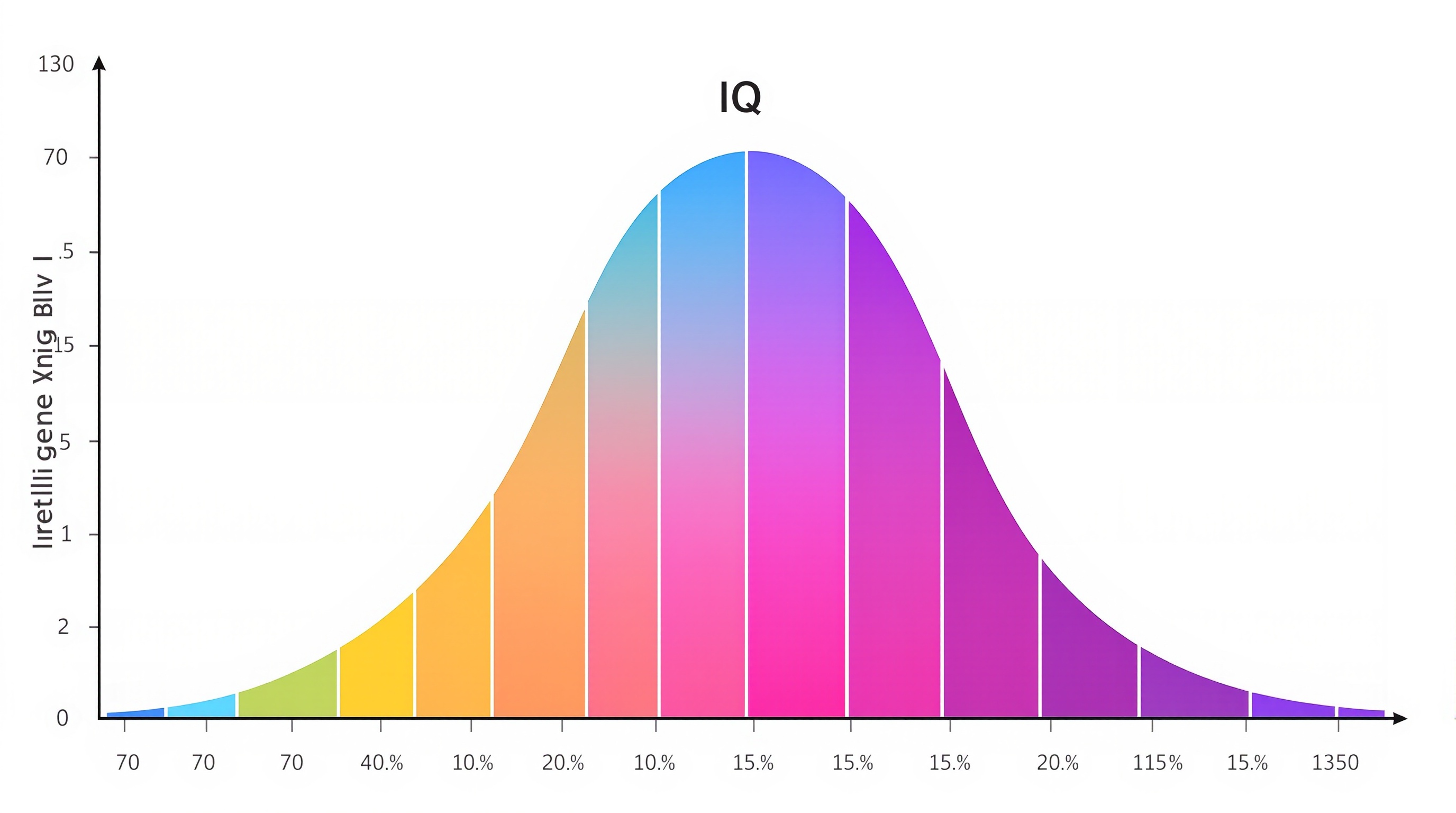
IQ scores follow a bell curve (also called a normal distribution). This means most people cluster around the average, with fewer people at the extremes.
Key Insight: The average IQ is set at 100 by design. The standard deviation is 15 points. This means 68% of people score between 85-115, and 95% score between 70-130.
How IQ Scores Are Calculated
Your IQ score isn't just "number of questions you got right." It's more sophisticated than that:
Raw Score Calculation
Your correct answers are tallied across different cognitive domains
Age Group Normalization
Scores are adjusted based on your age group for fair comparison
Population Comparison
Your performance is compared to a representative sample of the population
Standardized Score Conversion
Raw scores are converted to the standard IQ scale (mean 100, SD 15)
What IQ Actually Measures
IQ tests measure several cognitive domains:
Logical Reasoning
Pattern recognition and deductive thinking
Mathematical Ability
Numerical reasoning and problem-solving
Verbal Comprehension
Language understanding and vocabulary
Spatial Reasoning
Visual-spatial processing and mental rotation
Processing Speed
How quickly you can process information
Working Memory
Ability to hold and manipulate information
IQ Score Ranges: What They Mean
Here's what each IQ range actually means in practical terms:
Genius Level (145-160)
145–160Exceptional cognitive abilities. Top 0.1% of the population. Often associated with groundbreaking achievements in science, mathematics, or creative fields.
Very Gifted (130-144)
130–144Highly superior intelligence. Top 2% of the population. Strong academic performance, advanced problem-solving, and rapid learning abilities.
Gifted (115-129)
115–129Above average intelligence. Top 16% of the population. Excellent academic potential and strong analytical thinking skills.
Above Average (100-114)
100–114High average intelligence. 50th-84th percentile. Good learning capacity and solid reasoning abilities with proper effort.
Average (85-99)
85–99Normal intelligence. 16th-50th percentile. Most people fall within this range and can succeed in various fields with dedication.
Below Average (70-84)
70–84Low average intelligence. 2nd-16th percentile. May require additional support in academic or complex professional settings.
Borderline (55-69)
55–69Borderline intellectual functioning. Often requires specialized educational support and structured learning environments.
Intellectually Challenged (40-54)
40–54Significant cognitive limitations requiring substantial support in daily living and learning activities.
Important Note
IQ scores are just one measure of cognitive ability. Success in life depends on many factors including emotional intelligence, creativity, motivation, and practical skills.
Understanding Percentiles
Percentiles show what percentage of the population scored below your IQ score. This provides context for understanding your cognitive abilities relative to others.
IQ Score
Percentile Rank
What This Means
An IQ of 100 means you scored higher than 50% of people (average)
An IQ of 115 means you scored higher than 84% of people (above average)
An IQ of 130 means you scored higher than 98% of people (very superior)
What IQ Tests Don't Measure
While IQ tests provide valuable insights, they don't capture everything that makes you intelligent:
Emotional Intelligence
IQ tests don't measure your ability to understand and manage emotions, which is crucial for relationships and leadership.
Creativity & Innovation
Traditional IQ tests don't effectively measure creative thinking, artistic abilities, or innovative problem-solving.
Social Intelligence
Your ability to navigate social situations, read people, and build relationships isn't captured by IQ tests.
Motivation & Drive
Test performance can be affected by motivation, test anxiety, and other factors unrelated to actual cognitive ability.
Wisdom & Judgment
Practical wisdom, good judgment, and real-world problem-solving aren't measured by standard IQ assessments.
The Bottom Line
IQ is just one piece of the puzzle. Success in life depends on emotional intelligence, creativity, motivation, social skills, and many other factors that IQ tests don't measure.
What to Do With Your IQ Score
Now that you understand your IQ score, here's how to use this information constructively:
Take a Reliable Test
Start with a scientifically validated IQ test to get an accurate baseline of your cognitive abilities across multiple domains.
Understand Your Results
Review your score breakdown by cognitive domain. Identify your strengths and areas where you can improve.
Focus on Growth
Use your results to create a personalized cognitive development plan. Focus on areas where improvement will have the biggest impact.
Develop Complementary Skills
Remember that IQ is just one factor. Work on emotional intelligence, creativity, communication, and other skills that contribute to success.
Ready to Discover Your IQ?
Take our scientifically validated test and get detailed insights in minutes
Start Your Free IQ TestFrequently Asked Questions
Common questions about IQ scores answered
iq-scores-explained.relatedArticles.title
iq-scores-explained.relatedArticles.subtitle
iq-scores-explained.relatedArticles.articles.whatIsIq.title
iq-scores-explained.relatedArticles.articles.whatIsIq.description
iq-scores-explained.relatedArticles.articles.improveIq.title
iq-scores-explained.relatedArticles.articles.improveIq.description
iq-scores-explained.relatedArticles.articles.testAccuracy.title
iq-scores-explained.relatedArticles.articles.testAccuracy.description
Discover Your True Cognitive Potential
Take our scientifically validated IQ test and get detailed insights into your cognitive abilities
20-Minute Test
Complete assessment in just 20 minutes
98.7% Accuracy
Scientifically validated and reliable
Detailed Report
Comprehensive breakdown by cognitive domain
2.1M+ tests completed • No registration required • Instant results